
NOT ALL corneal cross-linking treatments are the same.
ONLY iLink is FDA-approved & covered by insurance.
Using Photrexa® Viscous (riboflavin 5’-phosphate in 20% dextran ophthalmic solution), Photrexa® (riboflavin 5’-phosphate ophthalmic solution), and the KXL® system, the iLink™ corneal cross-linking procedure from Glaukos is the only FDA-approved therapeutic treatment for patients with progressive keratoconus and corneal ectasia following refractive surgery.
Have you asked your doctor if the cross-linking they perform is FDA-approved and covered by insurance?
Visit our physician locator to view the list of doctors performing iLink FDA-approved cross-linking in the U.S.
Why iLink?

Proven Safe & Effective.
iLink corneal cross-linking is a minimally invasive FDA-approved treatment proven to be safe and effective in slowing or halting the progression of keratoconus to preserve vision.

FDA-Approved.
iLink is the only FDA-approved corneal cross-linking procedure and has been approved in the United States since April 2016.

Validated in Clinical Trials.
iLink has been fully validated through randomized, controlled pivotal clinical trials that formed the basis of the FDA approval, demonstrating the efficacy and safety of the pharmaceutical eye drops, device, and procedure.

Widely Covered by Insurance.
iLink cross-linking is widely covered by insurance and is the ONLY cross-linking procedure eligible for reimbursement in the U.S.
You may want to consider seeking a second opinion if:
- Only iLink cross-linking with the Photrexa drug formulations and the KXL System are approved by the FDA.
- Don’t risk your vision on a product or procedure that does not have proven safety and efficacy. If your keratoconus is not effectively treated and continues to progress, you may lose vision that cannot be recovered. Ask your doctor if iLink may be right for you.
Your doctor asks you to pay cash and submit to insurance on your own OR your doctor tells you that cross-linking is not covered by insurance.
- iLink FDA-approved cross-linking is widely covered by insurance and is the ONLY cross-linking procedure eligible for reimbursement in the U.S.
- Greater than 95% of the commercially insured population in all 50 states has coverage for the iLink procedure.
- If your doctor is using iLink FDA-approved cross-linking they will be able to bill your insurance directly, in most cases.
Your doctor suggests you pay for treatment as part of their own trial.
- Clinical trials leading to FDA-approval do not typically charge patients out of pocket for treatment or post-operative care. [see SACHRP Committee Recommendations: Charging Subjects for Clinical Trial Participation (2019)]
- A clinical trial for an investigational drug conducted with only the approval of an Institutional Review Board (IRB), and not conducted under an Investigational New Drug (IND) application that has been registered under the FDA, is unlawful and illegal, except for limited exceptions.
- You should ask for proof that the FDA has granted the practice permission to charge for the investigational drug.
Key Differences Between iLink and Non-FDA Approved Procedures:
iLink vs Illegal or Unapproved Cross-Linking FAQs
Why did my doctor say that cross-linking is experimental?
The cross-linking procedure that your doctor performs may use an experimental drug or device, however, there is an FDA-approved treatment option that is widely covered by insurance. To find a doctor offering the iLink FDA-approved cross-linking procedure, visit our physician locator (LINK).
My doctor says they will only perform epi-on because it is safer and has fewer potential side-effects – is this true?
There is no epi-on cross-linking procedure designated as safe and effective by the FDA. While side effects from approved treatments are reported to the FDA, negative outcomes with unapproved products are not reported or tracked. Therefore, the potential side effects with epi-on procedures are still unknown.
My doctor says epi-on is faster, less painful recovery after the procedure, without any difference in therapeutic efficacy – is this true?
The exact duration of the procedure may vary based on the equipment used, however this one-time procedure is intended to treat a long-term disease. This is why it is so important to choose the FDA-approved therapy that has been proven safe and effective in rigorous clinical trials.
My doctor says that they are performing cross-linking under an IRB clinical trial. What does this mean?
- An IRB is an Institutional Review Board, also known as an Ethics Committee, which oversees the ethical conduct of clinical studies. Obtaining IRB approval is a necessary and important step in conducting clinical research using investigational drugs, but it is not the only step.
- Another key requirement is to obtain approval to conduct research under an IND, or Investigational New Drug application, with the FDA. In additional to details like the design of the clinical trial, this application includes information pertaining to the composition, stability, and controls used for manufacturing the drug used in the clinical study.
- This rule is in place for patient safety, and it is illegal to conduct studies of investigational drugs in the United States without an effective IND in place.
- You should ask your doctor whether the study is being conducted under an IND, and to explain to you what alternatives there are to the investigational drugs being offered to you.
What riboflavin is used in illegal or unapproved epi-on crosslinking procedures?
The term “riboflavin” is a casual term that is used to simplify the name of the active ingredient, riboflavin-5’phosphate, that is used in the ophthalmic solutions applied during the cross-linking procedure. While unapproved formulations of this drug contain a form of riboflavin, the exact composition of the formulation, including the purity of the drug product, differs from the approved drug product that has been rigorously tested and approved. In many cases, riboflavin product used in unapproved cross-linking procedures have been illegally imported from outside of the US, without appropriate controls to ensure the product has been manufactured and stored according to US pharmaceutical standards.
What device is used in illegal or unapproved crosslinking procedures?
An unapproved device may have been illegally imported and has not been studied, reviewed for safety by FDA.

There are also known unapproved cross-linking procedures offered in the U.S. where the device has only been approved for dermatological or animal use.
Is corneal cross-linking covered by insurance?
- iLink FDA-approved cross-linking is the ONLY corneal cross-linking procedure eligible for reimbursement in the U.S. and is widely covered by insurance.
- Greater than 95% of the commercially insured population in all 50 states has coverage for the iLink procedure. Ask your doctor if iLink may be right for you.
Why hasn’t an epi-on procedure been FDA-approved?
- For an epi-on procedure to be approved, the FDA would need to review a complete submission package, including the outcomes of clinical trials conducted in support of the application. The review is to determine whether the information submitted adequately demonstrates that the products will be safe and effective when used as described in the product labeling, and that they will be properly manufactured.
- Glaukos has recently completed a Phase 3 clinical trial under an IND to evaluate a new drug & device for epi-on cross-linking to support a New Drug Application for the procedure, however the application has not yet undergone FDA review.
Why does FDA approval matter?
- Drug manufacturers spend years in pre-clinical development and three phases of clinical trials under tight controls to ensure the safety and efficacy of their products and procedures to protect patients.
- Upon submission, the FDA carefully vets new devices and drugs via panels of experts and specialists.
- Approval is granted based on credible, statistically significant research trials demonstrating safety and efficacy with strict post-market tracking, marketing, and quality monitoring requirements.
What is the FDA’s position on unapproved drugs and/or devices?
- For unapproved drugs and devices, the FDA has not determined that they are safe and effective; they may not be approved for use outside of the clinical trials authorized by the FDA and they may not be legally marketed to patients.
- While manufacturers of FDA-approved drugs and devices are required to report negative patient outcomes to the FDA, there is no equivalent reporting process in place for unapproved products, which may present a risk to public safety.
Approved by the FDA
Non-FDA Approved and/or Illegal


Non-FDA Approved and/or Illegal
How can you make sure you are receiving the FDA-approved procedure?
Check our physician locator to make sure your doctor is listed! This list includes the U.S. physicians performing iLink FDA-approved cross-linking.
Why does FDA-approved matter?
- Drug manufacturers spend years in pre-clinical development and three phases of clinical trials to ensure the safety and efficacy of their products and procedures.
- Upon submission, the FDA carefully vets new candidates and drugs via panels of experts and specialists.
- Approval is granted based on credible, statistically significant research trials demonstrating safety and efficacy with strict post-marketing tracking, marketing and quality monitoring requirements.
- For unapproved drugs and devices, the FDA has not determined that they are safe and effective; they may not be approved for use outside of clinical trials authorized by the FDA and they may not be legally marketed to patients.
- While manufacturers of FDA-approved drugs and devices are required to report adverse experiences to the FDA, there is no equivalent reporting required for unapproved products, which may present a risk to public safety.
Efficacy of the FDA-Approved iLink Cross-Linking Procedure vs Unapproved Cross-Linking Procedures
- Only iLink has been proven safe and effective by the FDA
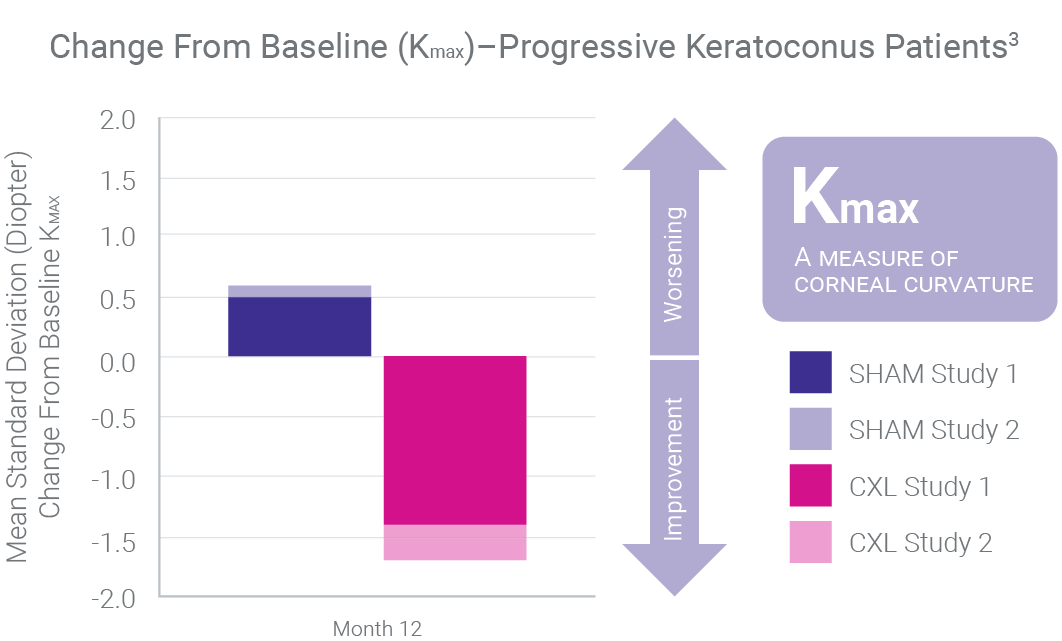
- Clinical trials demonstrated that the iLink cross-linking procedure is effective in slowing or halting the progression of keratoconus. In the study that led to the FDA-approval of iLink, patients who did not undergo cross-linking continued to progress, while patients who underwent iLink cross-linking did not progress
- The goal of the iLink cross-linking procedure is slow or halt the progression of keratoconus to preserve vision.
Top Questions to Ask Your Eye Doctor
What’s more important than your sight?
Don’t risk your vision on a product or procedure that does not have proven safety and efficacy. If your keratoconus is not effectively treated and continues to progress, you may lose vision that cannot be recovered.
Have you asked your doctor if the cross-linking they perform is FDA-approved and covered by insurance?
Visit our physician locator to view the list of doctors performing iLink FDA-approved cross-linking in the U.S.
1. Hersh PS, Stulting RD, Muller D, et al; U.S. Crosslinking Study Group. S. Multicenter Clinical Trial of Corneal Collagen Crosslinking for Treatment of Corneal Ectasia after Refractive Surgery. Ophthalmology 2017;124(9):1475-84.
2. Hersh PS, Stulting RD, Muller D, et al; U.S. Crosslinking Study Group. United States Multicenter Clinical Trial of Corneal Collagen Crosslinking for Keratoconus Treatment. Ophthalmology 2017; 124(9):1259-70.
3. Photrexa [package insert]. Waltham, MA: Glaukos, Inc. 2016.
© 2021 Glaukos Corporation. iLink ™ is a trademark of Glaukos Corporation. Photrexa ® and KXL® are registered trademarks of Avedro, Inc, a Glaukos Company.
MA-02113 Rev 2